
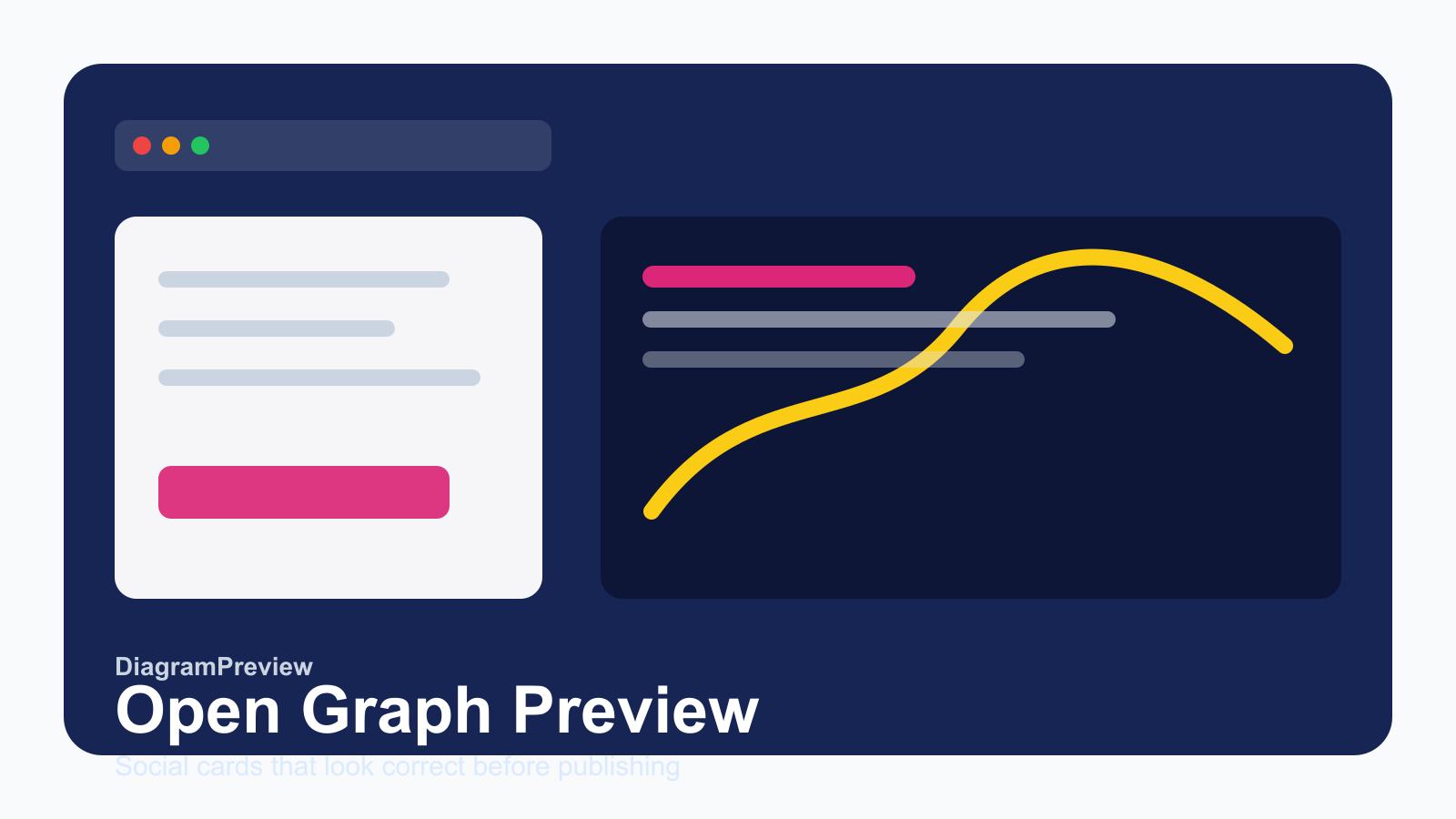
Your blog post has one second to look trustworthy in a social card
A long-tail developer preview guide that combines Open Graph preview and SVG cover checks with realistic snippets for checking AI-generated output, API debugging material, and publishing previews.
This topic is now covered in a more complete workflow guide.
Recommended primary article: Before publishing technical docs, preview Markdown, SVG, Open Graph, and screenshots
Por que adicionar uma etapa de prévia
Many developer artifacts now come from AI prompts, browser DevTools exports, API contracts, or infrastructure configuration. The hard part is not generating text; it is seeing whether the generated text behaves the way you expect.
Your blog post has one second to look trustworthy in a social card focuses on turning source text into a preview surface. You can inspect structure, routing, metadata, or timing without setting up a full environment first.
Entrada de exemplo
Start with the smallest reproducible snippet: one HAR entry, one SVG, one JSONPath expression, a few Open Graph tags, or a compact Nginx location block. Small input makes parser problems easier to isolate.
The snippet below is intentionally small. It should produce an observable preview immediately, then you can expand toward production input.
<meta property="og:title" content="Debug HAR waterfalls before blaming the backend" />
<meta property="og:image" content="https://diagrampreview.com/blog/har-file-viewer-api-waterfall-debugging.png" />O que inspecionar
First check whether the structure matches your expectation: request order, field hierarchy, routing precedence, card title, and preview image. Then look for anomalies such as slow requests, 4xx/5xx responses, empty matches, invalid SVG, or fallback routes.
If the preview grows too large, split it into focused views. Request flow, schema, routing, publishing preview, and monitoring are easier to rank and easier to understand as separate pages.
Fluxo prático
A reliable loop is: generate or export the first draft, paste it into the matching preview tool, fix the source based on preview feedback, then publish the source, screenshot, and exported artifact together.
The search value comes from specific, verifiable problems. People often search for HAR waterfall, JSONPath tester, Nginx location matching, or OG preview rather than a generic diagram tool.
Notas de publicação
When publishing, avoid describing the page as just an online tool. Explain the input shape, the bugs the preview can reveal, and the boundaries that still require the original tool or production environment.
For developer communities, write it as a debugging note instead of an ad. Snippets, mistakes, and screenshots earn more useful feedback than slogans.